Saturday, 30 April 2011

Raging Bull (1980) Directed by Martin Scorsese


Astrid: 
Raging Bull is great cinematic storytelling. It is visual narration at a high artistic level. It is admirable dedicated acting. Its cast and makers are all the best, most creative and professional people around.
It's black and white, it knowingly situates itself in the history of cinema while producing something entirely new out of a Hollywood favorite; a true story. Raging Bull is so good, it almost becomes boring.

It is a narrative storytelling classic to take an unsympathetic character and tell a story portraying him without judgment to any direction. There used to be an unpronounced preference for these stories because as we know, life is often ambiguous and art is the place to deal with that. Right now I feel there is a needed shift in arts taking place towards a more openly subjective work. Endless ambiguity can be distancing and uninvolving. Never-ending acceptance and understanding can be damaging to our sense of self.

This time I watched Raging Bull and hovered between being entertained, bored and disgusted. Jake La Motta, as played by De Niro, is a disturbing, controlling and violent person. I could not find anything to like in him. I don't have to like him – that's my realization. I don't even have to empathize or try to understand. There was entertainment: plot turns, great acting, fabulous period detail, admirable movie-making. Yet, I am left with the question SO WHAT, and that is not a very great mental place to be in after a film.


Nick :
I recall walking home from an evening at a friends house many years ago (I was barely 20 years old). It was late, gone one in the morning. The streets were bare. All of a sudden a figure appeared walking towards me. In a flash, the stranger was thumping me in the face. He hit me quite a few times, very hard. Standing in shock, I heard a voice behind him telling him to go. Without a word or explanation for the attack, he left and I was left with a sore head. There was no reason for the attack, no provocation (as if that would justify the strangers actions).This kind of casual violence I've experienced a few times in my life. I've come across the type of person like the boxer Jake La Motta. A scary, no-messing, psychotic, paranoid, obsessive violent thug. Oh yeah, and I still like watching violent movies. Go figure?

Raging Bull is a deceptive film. The first few times I saw the picture, I was mistaken into thinking it was a real-life bio-pic. But as I've grown older, I've realized that along with Robert De Niro's fake nose, everything in this picture is super-stylized, almost superficial. The celebrated fight scenes, orchestrated and overblown. You'll find as much genius editing, interesting camera angles, and Scorsese's usual arsenal of tricks as in any one of his other pictures. De Niro as La Motta is a grotesque, both as a young lean boxer and as the middle aged man who has lost everything apart from his sense of humor. Yes, he is good in this role, but again, every word and action is exaggerated. Playing the part of his brother Joey, a restrained Joe Pesci matches De Niro here.

But that exaggeration and over-the-top performance from De Niro is what makes Raging Bull work. Yes, it's like Rocky with grit. It's still a soap opera. One of the powerful aspects of Scorsese's bio-pic is that we rarely see a character like La Motta dominate a film nowadays. Raging Bull stands up to scrutiny, it's one of the celebrated films that deserves its reputation. I've always found new things in the picture whenever I've seen it. Was it deliberate for Scorsese to record the dialogue so quietly? Was the reason to enhance the sound of the violent scenes? Or was it just bad sound? Or my last thoughts this time around adhere me to consider that this school of machismo and male dominance as portrayed on screen in Raging Bull is verging on parody and dated.

Wednesday, 27 April 2011

The Fortune (1974) Directed by Mike Nichols


Nick:
Can you smell it? It's steaming? It's on the pavement, just over there, don't step in it!...oh...yes, it's a turd. Of course, if you excuse the shit analogy, I'm really talking about expectation. The cruelest way to refer to a failure or a let down, is to bring out the turd. This year, I've experienced a few. The new Cut Copy album, the Finnish election results, Spurs' collapse against Real Madrid and the book I'm currently reading; Star : The Life & Wild Times of Warren Beatty by Peter Biskind. I've enjoyed Biskind's gossipy tales in the past, but 400 pages into his Beatty tome you realize Biskind has got no real idea who Beatty is and why, occasionally, Beatty was a cinema zeitgeist. To be fair, it piqued my interest enough to revisit The Fortune, a film that has had over the years a reputation akin to that steaming pile of...oh you get the idea!

You won't find much zeitgeist in The Fortune. When I first watched this film a couple of years ago, I was forgiving. It was hard to find, a neglected New Hollywood picture that featured Beatty and Jack Nicholson, both in their respective primes. It's directed by the often good Nichols, so why was this picture so not rated? In a clearer frame of mind it's fair to say that farce, combined with hammy hysterical acting and jokes that fall flat (although there are a few laughs) just add to the general feeling that everyone was lost making The Fortune. Nichols shoots from a distance, we never get close to the characters. Beatty and Nicholson try to find some comic chemistry, but both are cast against type, so they struggle for empathy. Worst of all, you never believe that either Lothario would waste their time on the pretty yet plain Stockard Channing, even if they are trying to swindle her out of her fortune.

Saving graces here, as in most Hollywood pictures at this time is that it looks good, and the period feel (1920's) is well evoked. But an hour into The Fortune you wonder how any of the principles didn't begin to feel how flat all this over acting was going to be and if they all lost interest. A curiosity at best, sadly The Fortune's reputation is deserved. A missed opportunity still.


Astrid:
I like Mike Nichols and I love Jack Nicholson and I grimace and admit to liking Warren Beatty. I really love the 1970s cinema. And the 1970s as the romantic chaotic decade before I was born into this world. Yet, somehow The Fortune fails to impress me.

The Fortune is a hostile movie. I'm not certain how much of it is in the script and how much of it is in Warren's and Jack's performances (they cannot hide their disappointment at the looks of the leading lady). Anyhow, what is supposed to be funny and satirical turns into an embarrassing and serious story. It's Jack already playing his usual crazy hair-sticking-up jerk and Warren stiffly portraying a controlling and flawed lover boy. There were a few times that I chuckled though, and Stockard Channing was alright.

I guess the hostility of the film is in its narrative: how to kill a woman for her money and get away with it. That's the question of the film. When I write it down it becomes clear that it's a simplistic and boring subject matter. Well, at least she does not die that easily. Amongst all the fresh new feminist rhetoric and the joys of the freed Western woman, the 1970s was boiling over with open hatred towards women. The Fortune is a reminder of that.

Monday, 25 April 2011

The Life Aquatic with Steve Zissou (2004) Directed by Wes Anderson

Astrid:
The Life Aquatic With Steve Zissou has been one of my favorite feel-good movies since I first saw it six years ago. I have not seen it for many years though, and this time around I realized it's not really a feel-good film. What does that say about me? What kind of a person feels comforted and happy watching a strange twisted story about a mid-life crises, dysfunctional relationships, dying loved ones and a father-son relationship, which is based on not knowing each other? A not very conventionally happy person I guess. Someone who feel familiar with dysfunction in relationships. What about the mid-life crises? I was 23 when I first watched this movie.

I still know nothing about mid-life crises. But I love Bill Murray as Steve Zissou. I also love him as the washed-up actor in Lost In Translation, a film published a year before The Life Aquatic With Steve Zissou, in 2003. It feels as if Murray is pretty much a continuation or an expansion of the same character here. As someone notes on the extras to The Life Aquatic, it is difficult to know where the role begins and Murray ends. Feeling lost and uncomfortable, pressured and distanced from one's own life is not of course only a privilege of the mid-lifers. The Life Aquatic has a pregnant journalist who is separating from her married lover while drifting at sea with Zissou's gang, it has a long-lost son who shows up after his mother has died, and it has a host of other characters equally struggling for a place in their changing lives.

Life is always changing in the movies. Static existence does not make good narrative and it is unrealistic too. The reason that must have weighed heavily on The Life Aquatic gaining its status as one of my feel-good movies in the mid-noughties is Wes Anderson's aesthetics. He does detail, he does color and style. Another reason why I had a special relationship to this film is that it was one of our first DVDs that we actually owned. Owning things creates repetition. Repetition is safety.

Nick:
As a child in the school playground, I would peruse my fellow student's satchels and duffel bags for any signs of badges or iron-on patches. Strange behavior you might think, but any badge or such notice of fandom would invariably be unique and belong to an exclusive fan club. I remember distinctly at the age of eight my mate Andy having the coolest Planet of the Apes badges, only available to fan club members of the TV series. Abba, Evil Knievel, Starsky & Hutch and quite possibly Jacques Cousteau were all ripe for fan club indulgence. I was too poor to subscribe to any fan clubs, but I did manage to trade comics for Planet Of The Apes, Abba and The Fonz from Happy Days badges. All boys' own stuff if you like (except the super girly Abba). I mention Jacques Cousteau as he was the underwater explorer of the era (early 1970's) and The Life Aquatic with Steve Zissou pays homage to Cousteau, although, in reality it's a bit more complicated than that.

Wes Anderson always has a strong sense of family and relationship in his films. From Rushmore through to The Royal Tenenbaums and onto The Darjeeling Limited, dysfunctional, lost family members reunited under trying circumstances dominate his films. The Life Aquatic with Steve Zissou continues these themes under the backdrop of the life of undersea explorer and documentary film maker Steve Zissou (played by the effortless Bill Murray).  Steve's life, far from going well is in a rut. His legend is fading, his movies flop, his best friend has been devoured by some new species of shark and his marriage is a sham. His vessel, The Belafonte needs replenishing and his crew, although loyal are weary. But into Steve's life appears his possible son from a previous relationship (Owen Wilson as Ned) which belatedly ignites Steve's sense of fatherhood whilst against all odds pushing him to new deep-sea adventures.

The Life Aquatic with Steve Zissou is eccentricity incarnate and often very funny while keeping the emotional tug strong. Anderson supplies great support for Murray and Wilson, with a reverent portrayal of Angelica Huston (Anderson remembers how Huston should look on screen), Willem Dafoe, Cate Blanchett, Jeff Goldblum and Michael Gambon all delightful. Color co-ordination of every amazing set is exquisite, photography richer than a 1970's copy of National Geographic. The soundtrack, as usual with an Anderson movie, is knowing and uplifting. This is a rich feast for the senses. But Anderson doesn't stop there, because not only is The Life Aquatic with Steve Zissou an original in almost every sense, it reminds us that nothing pulls and tears us apart quite like the inner or outer turmoils of families we all strive to be part of. Just watch and wonder.

Thursday, 21 April 2011

Erin Brockovich (2000) Directed by Steven Soderbergh


Nick:
Let's leave the sentimentality at the door. It's a trait that can effect the best artistic endeavors. Lets not confuse sentimental feelings for real emotion. What's impressive about Erin Brockovich is it never brings sentimentality to the table. Erin Brockovich could be one of the last great American mainstream films.

This film deals with class, sexism in the work place, human rights, big corporate corruption and anything else you want to throw into the kitchen sink. Yes, it's a political beast with a David & Goliath bent. But what make Erin Brockovich work is that Soderbergh never forgets to entertain. The script is sharp and foul mouthed. Erin as portrayed by Julia Roberts is an old-school New Hollywood turn. Roberts is an actress I've not particularly enjoyed on screen (although she seems to save her best work for Soderbergh), but this is one of the least self-conscious turns by a mainstream actor I've seen. Yes, she carries the film.   

Albert Finney is perfect as the head of the law firm that employs Erin. Finney has rarely been so well used in recent years. All the bit parts are well cast and as is typical with Soderbergh there is a lightness of touch which seems effortless. He's a director when on form, as he is here, never feels like he intrudes on the storytelling. You don't feel there is heavy moralising going on. The fact that this is a true story only confirms the injustice we already know exists amongst the world of big coprporate business. If you've shied away from this picture in the past, thinking of it as just more maintream fluff, leave your prejudice at the door and check it out. Smart and vital cinema such as this is rare these days.

Astrid:
I wonder if the True Finns (Perussuomalaiset) party who just marched in force into the next government of Finland see themselves as a kind of Erin Brockovich phenomenon? Mr. and Mrs. Avarage saving the world from the evils of corporate power? Who knows what they plan at this point...

Although I have long since missed out on becoming the next Erin B – I am over-educated, fearful and I don't have Julia Roberts' looks – Erin Brockovich is still an entertaining and strangely empowering movie. I love its claim on reality, because Erin really does exist and has won her fight against an evil corporation. Once in a while it is nice to know that the stories of cinema have a connection to our non-movie-like realities. And sometimes something positive happens in life, not only in movies.

Erin Brockovich says: you can have prominent boobs, know it and still be able to think, fight and argue for yourself. I guess something in that statement continues to be revolutionary to some of us.
 The film also shows that even though a woman has three children, it can be crucial to her to build an identity through her work, be recognized for her influence in society. Also, this movie does not claim that Erin would be happiest if she listened to her motorcycling boyfriend/neighbor and quit her job to play house with him. He fades away because her priority is her work.

Erin Brockovich is a call for common sense. I'm worried though that sometimes common sense can be hijacked by hillibillies and then it becomes oversimplification.

Saturday, 16 April 2011

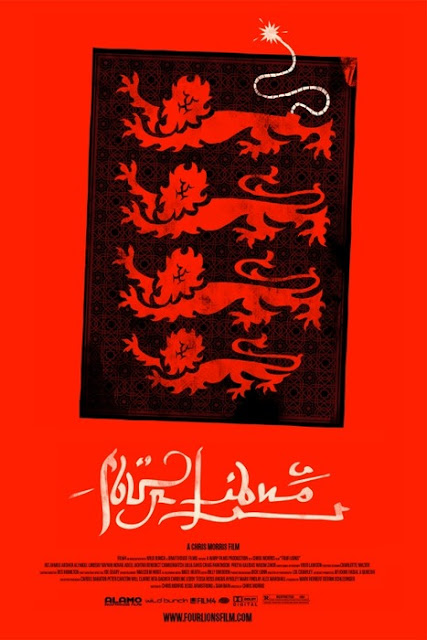
Four Lions (2010) & Dead Man (1995)


Astrid:
I know I should write about death here, but somehow I want to talk about the beauty of young men.
It took me a long time to appreciate Johnny Depp for his looks. I do now, I don't deny that. The way young men look used to be of no appeal to me because I mixed youth with unreliability, arrogance, disconnection between expression and intention. When I was the age of young men, I simply found men uninteresting. I was absorbed in women of all ages and older men. Maybe the problem was that I wanted to be a young man. I envied their place, their freedom, I saw a lot of freedom out of my reach.

The other night when we watched Dead Man, I was in pain and through the discomfort I lost myself and felt I looked exactly like Johnny Depp in Dead Man. I was also experiencing his discomfort on screen as if it was happening to me, so we had to stop for the evening. The next day I no longer felt such affinity. I was a woman watching a kind of rock'n'roll lost soul in a western. Beauty wasting away. Nick said he was lost and that was the point. I thought the point was the way he looks, but I didn't say anything.

Young men seem to have the freedom and naivety to act on completely short-sighted plans. It's a gendered privilege. Some can afford to play with their lives and die, they like the idea of war. Yes, many still do. There's always the talk of justification through necessity. Four Lions is a story of young men who plan a bomb attack in London. Their plans go wrong, the deaths that follow are not the right kind of death. How bizarre. I felt uneasy watching Four Lions. Comedy has a piercing way of highlighting the ideological contradictions that we continue to live with each day. Also, the stupidity of beautiful young men can sometimes be a tragedy in itself.

Nick :
For me it's a taken that people consider their mortality on a far deeper level in Finland than in other countries I've visited or lived in. I feel this on a spiritual level, not just on a depression level (although I think the harsh winter contributes to a certain level of contemplation in these matters). Death, either pending or delayed, is a common theme that links Four Lions and Dead Man.

Chris Morris acquired hero status for me many years ago through his work on The Day Today, Brass Eye, Blue Jam (Jam) and the only partially seen Nathan Barly. You could call him a black-humored satirist, but that simplifies matters. I'm sure Four Lions upset a lot of people who support the War On Terror with its subject matter:  the film follows a group of British Jihads' attempt to blow themselves and something up. I love the fact that Morris humanizes his Jihadists, they have a sense of humor about themselves and their religion. Amongst the laughs (there are many) Morris' film ultimately leaves a feeling of sadness and outrage. It's a crazy messed up world out there and even the birds have got to go come the final reckoning.

Is Johnny Depp any good? Before he hit his payday with the Pirate franchise, he was the doyen of many an art house picture.

 In Jim Jarmusch's abstract Western Dead Man,  his face, or more accurately, Robby Muller's cinematic capturing of his face brings so much to the film. Depp is pretty lost as the accountant on the run, intentionally I'm sure. Jarmusch adds a roll call of inspired bit players who drift in and out of this slow meander and make up for any lack of thespian craft: Robert Mitchum, John Hurt, Gabriel Byrne, Alfred Molina, Iggy Pop, Crispin Glover and Lance Henriksen to name a few. Gary Farmer as the Indian Nobody almost steals the film. Depp's face in black and white close up is a dream, as is the whole picture. Neil Young supplies the music, probably his last great work. Dead Man lives on in the subconscious, spiritually evoking a true sense of one's mortality mixed with dream like wonder. The last great Western?

Sunday, 10 April 2011

Yesterday, Today & Tomorrow (1963) Directed by Vittorio De Sica


Nick:
It can cause snickering. People start looking at you in a different light. Once, you could walk on air, then all of a sudden, everything you do is analyzed and evidence for the prosecution. A fall from greatness can be painful and irrefutable. Last night we watched the latest Woody Allen film, You Will Meet A Tall Dark Stranger. This along with Vicky Cristina Barcelona are two of the most vacuous films I've ever watched by anyone, let alone Allen. He seems to have forgotten what made him great. First clue: it starts with the script. In many respects, by the time De Sica got to Yesterday, Today & Tomorrow (Italian title : Ieri, Oggi, Domani), the same fate had befallen him as Allen. De Sica, once such a shrewd narrator of the Italian working classes on screen, descended into caricature, cliché and, worst of all, sentimentality.

It is easy to think De Sica saw Marcello Mastroianni and Sophia Loren and was starstruck. By now they were Italy's biggest screen exports, international superstars. With Yesterday, Today & Tomorrow, De Sica casts the two as the principle actors in three different stories which cover the post-war Italian class system from top to bottom. You could look at this film as being about the three different women that Loren portrays and her relationship to men. A pre-1960's life in Naples selling cigarettes in the street and conceiving to keep the roof over your head and avoid prison, a millionaire woman driving around Milan picking up artisans to relieve her boredom, a flirtatious upper class hooker in Rome. Loren is very good in these roles, Yesterday, Today & Tomorrow shows us something she rarely gave in English language films.

Mastroianni feels wasted in all of these stories, you miss his cool presence from his earlier Fellini movies. In short, all three stories are farces and here lies the problem. De Sica, still sees these gentle comic tales as a means to make comments on class distinctions, but the edge had gone from his commentary by this stage. Was he too comfortable? Probably. There's still a lot to admire in the look of the film, especially in De Sica's nod to the French New Wave of the Milanese set road story. Loren's strip in the third part is the highlight here, her sensual playfulness shows a daring missing in most of this three-hander.

Astrid:
Sophia Loren is a goddess. There is a sense of humor in her and it works wonders for perfection. It humanizes the inhuman beauty. I once had a neighbor who liked quilting and breeding. She was extremely beautiful so it was not difficult for her to arrange new pregnancies. It was her influence that I learned to read Vogue – I fell in love with the vacuousness of the presentation. It was also my first encounter with the privilege of having money. I was a child, impressible and eager to turn into a swan and let go of the awkward rubber duck inside me.

But what about the fact that this beautiful emancipated neighbor seemed to make mothering her main purpose in life? Should this be a question about sex or babies? In Yesterday, Today, & Tomorrow Sophia Loren plays three different women: a mother, a whore and a crude lost rich woman. The Italian stereotype of women as either mothers or whores is alive and well in this piece of cinema from 1963.
I'm not sure if the film offered any special perspective into the stereotyping of women.
At the same time, I'm convinced that De Sica is splitting his work into three sections like this and keeping the same actors in tow, precisely because he wants to portray them as sides to one woman. So, the perspective must be somewhere. Perhaps it holds no power of subversion and thus evades me completely.

Feminine beauty in its 20th century splendor requires endless work and reconstruction. The resulting aesthetic has been passed on to me via literature as well as the above mentioned neighbor and cinema. The novel Wonderful Women By The Sea by Monica Fagerholm was another early influence on my personal feminine aesthetic (in good and bad, obsession and health). The novel by Fagerholm and Yesterday, Today & Tomorrow share a time context. They take place in the 1960s. That's important. It is around then that the yearning for a personal freedom becomes a requirement for beauty, it changes and complicates the purpose of beauty. It questions reproduction as the end result. It renders Marchello Mastroianni a helpless clown.

Tuesday, 5 April 2011

Mystery Train (1989) Directed by Jim Jarmusch

Astrid:
I know I am someone who is supposed to have watched the Jim Jarmusch catalogue of movies a long time ago, but this was my third ever Jarmusch film. Mystery Train speaks in a visual and narrative language I find easy and inspiring to relate to. It finds outsider perspectives to the insider identity. The story breaths letting the viewer feel, interpret and analyze however much or little they want. The most powerful cinematic tool, the visual images are telling most of the story. That's rare in 1989 and it's rare today.

There is a lightness and a kind of nonchalant rock'n'roll attitude to the Jarmusch films I have so far experienced – Mystery Train definitely has it too. Even though bad things happen in life, you can always take off, change the scenery, still wear the red lipstick and keep your dignitity. Or if you can't hold on to dignity, maybe your life is enough. Maybe that's the message.

I've never been to Memphis or that southern part of the USA, but I'll be satisfied in seeing it in pictures and through the eyes of others. I'm afraid the reality would be somewhat different to the Jarmusch version. The Memphis pilgrimage time has passed me by. I hate finding myself in tourist crowds and I have already tasted pancakes with syrup and blueberries and banana and cream. Now I'm going to fix myself a bowl of ice-cream with canned peaches and I'll give some to my panicked boyfriend too.

Nick :
I write this review under duress. My football team (Spurs) play in the Champions League this evening. It could be our biggest moment yet in the modern football era. On top of this, we just finished watching the whole of Deadwood. Yes all three seasons. A big hole has now appeared in our lives from today onwards. How will we cope with the withdrawal symptoms? I just have to convince Astrid that The Prisoner box set sitting on the shelf is of equal quality (it certainly is) and hopefully we can get our TV series fix back under way. Music creativity is afoot in our house too, on multiple fronts. It makes sense to visit a film that pays homage in some way to the origins of popular music.

Rock'n' Roll iconography doesn't get any bigger than Elvis Presley. Mystery Train is drenched in Elvis (and named after an Elvis song). Elvis is in the hotel rooms, the street corners of Memphis, the smalltalk and the background noise that fills Mystery Train. Three stories, which occur simultaneously, often in the same seedy Memphis hotel makes up the premise of Mystery Train: The Japanese couple who visit Memphis to see the historical landmarks (Sun Studio, Graceland). Then there is an Italian woman transporting her husband's coffin back to Rome and who is visited by Elvis' ghost. And finally the crazed, gun-popping Englishman everyone knows as Elvis (a lean and mean Joe Strummer). Their lives are entwined in the slow everyday grind of Memphis real life and folklore.

Mystery Train deals with the Other, especially the foreigner in America (one theme that unites all three stories). Cultural differences amid the frank squalor in which Jarmusch depicts Memphis are the order of the day. Jarmusch's film reminds me of a time when American independent cinema was a unique voice and you never quite knew what you were getting. Jarmusch was at the forefront of a new breed of like minded film makers, what happened? Mystery Train still breathes a healthy sigh. All aboard...

Friday, 1 April 2011

The Witches of Eastwick (1987) Directed by George Miller


Nick:
Today I crashed my Ferrari sports car into a  Jumbo Jet that had crash-landed on the Helsinki Highway 666. As passengers fled the burning wreckage I somehow manged to disengage my car from the crumpled steel and aimed to make a quick getaway. Unfortunately the plane seems to have been a transatlantic flight and in my haste to flee the scene I ran over some fleeing passengers. Jack Nicholson, Cher, Michelle Pfeiffer and Susan Sarandon were all caught under the wheels of my raging horsepower. Of course, today is April Fools Day, so take my story at the expense of the stars of The Witches of Eastwick with a pinch of salt, please.

In reality, if such an occurrence happened way back in 1986, it may have saved us from this car wreck of a movie. I could point out this kind of star vehicle rarely credits the audience with much intelligence. The personalities of Nicholson and company is all we have to go on here. Slow direction by George Miller (this definitely has more in common with his Happy Feet rather than his Mad Max pictures), a puerile script, and giving Nicholson the license to overact creates an often painful watching experience.

Nicholson didn't ever recover in any meaningful way from this kind of role. Cher, Pfeiffer and Sarandon should have known better. We could go into The Witches of Eastwick's  representation of the genders, but I really can't be bothered. Not even good trash.

Astrid:
My memory serves me badly here, but I must have been less than 12-years-old when I first watched The Witches of Eastwick. I was staying the night with a very good girlfriend, sleeping on mattresses set out in front of the TV and somehow we ended up finding a VCR about witches...I remember this film had a lasting influence on me and my thinking on adulthood. It would be fun to grow up with my girlfriends and have our dreams answered in the form of a man. You know why it would be fun? Because for a short period we would have fun with pink balloons, gold-lame gowns and bog castles and then he would go crazy – like they do – but we could move on. That's what I learned. Also, it would be good to be one of these stereotypes: a blonde, a redhead or a brunette. I was very aware of the connotations. Later, I have tried all of the colors and am currently wavering between being Susan Sarandon and Michelle Pfeiffer.

Last night I felt a little worried for my childhood self. What sense had I made out of all the sexual talk? What preconditioning had I taken with me? Did I, like the movie seems to believe,  that lonely divorced women looking for sexual pleasure are likely to bring on the devil? Although Michelle, Cher and Susan are the superstars we know we can root for here, isn't it a bit worrying that after their pleasure and fulfillment they have to kill the man who they had it with?

Yes, I know The Witches of Eastwick is written like a Gothic tale and usually their prime content is presenting feminine sexuality as dangerous, disastrous even. But John Updike wrote the novel in the early 1980s, a couple hundred years late. I was offended by the chauvinist take this film has on women, gender equality and hetero relationships in general. The fact that it was made into a movie in 1987 situates it in the middle of a strong feminist backlash. Jack Nicholson's raging woman-hating Van Horne (the devil) is first citing basic gender equality arguments just to chuck them out for "What about me?" –Oh, you poor heterosexual men of the 80s! Is that the ultimate reason why they made this film?

LinkWithin

Related Posts Plugin for WordPress, Blogger...